
Updated October 13, 2026
Four hydroelectric dams on the Klamath River came down in 2023 and 2024, the largest dam removal in U.S. history. Salmon returned within weeks, and in July 2025 Native youth paddled the freed river from source to sea.
The four dams
Removal finished on October 2, 2024, opening more than 400 miles of habitat to salmon. (OPB)
| Dam | Details | Removed |
|---|---|---|
| Iron Gate | In service 1962; 173 feet tall (Arizona Republic) | 2024 |
| J.C. Boyle | Southern Oregon; named for engineer John C. Boyle (OPB) | 2024 |
| Copco No. 1 | Built 1922; 132 feet tall, the tallest of the four | 2024 |
| Copco No. 2 | Built 1925; 25 feet tall | 2023 |
Two smaller upstream dams, Keno and Link River, were not part of the deal. They have fish ladders and supply irrigation for the Klamath Project. (Herald and News)
Legal history
The removal took about 18 years of licensing fights and agreements after the dams’ federal license expired in 2006. Newest first:
| Date | Step | What happened |
|---|---|---|
| 2023–2024 | Demolition | Dams removed on a $450 million budget (Herald and News) |
| Nov. 17, 2022 | FERC approves surrender | Federal regulators approve giving up the license and removing the dams (FERC order) |
| June 17, 2021 | FERC approves transfer | License moves to the Klamath River Renewal Corporation (CRS) |
| 2020 | FERC balks | Regulators worry the nonprofit lacks dam removal experience; parties renegotiate (Courthouse News) |
| 2016 | Amended KHSA | New deal that skips Congress; creates the Klamath River Renewal Corporation (KRRC); PacifiCorp commits $200 million and steps away from liability (Herald and News, SF Chronicle) |
| 2013–2016 | Congress stalls | Bills to approve the 2010 agreements get hearings but never pass (CRS) |
| 2010 | KBRA and KHSA signed | Interior Secretary, Oregon and California governors, PacifiCorp and 44 other parties announce two settlement agreements (CRS) |
| 2006 | License expires | PacifiCorp keeps running the dams on temporary yearly licenses (CRS) |
| 1954 | First license | FERC licenses the Klamath Hydroelectric Project (PacifiCorp filing) |
Plain-English terms: FERC is the Federal Energy Regulatory Commission, which licenses hydroelectric dams. KHSA is the Klamath Hydroelectric Settlement Agreement, the dam removal deal. KBRA is the Klamath Basin Restoration Agreement, its companion deal on water and restoration.
Salmon return
Salmon came back faster than many biologists expected.
- October 2024: A Chinook salmon was seen at the former Iron Gate Dam site, likely the first in over a century. (onWater, citing CalTrout)
- Within a month: Hundreds of salmon were spawning in creeks cut off for decades. River water that October averaged 8°C (14°F) cooler than the prior nine Octobers, per KRRC. (AP / ABC News)
- 2025 run: The fall Chinook run was 61% of the 48-year average, well above forecast, per the California Department of Fish and Wildlife. (National Fisherman)
- October 2025: Chinook reached the river’s headwaters in Oregon. (New York Times, via SEJ)
- Ongoing: About 2,200 acres of former reservoir land are being replanted over several years. (OPB) Federal fishery managers gave an update as recently as September 2026. (Pacific Fishery Management Council)
The youth paddle
In July 2025, Native youth became the first in a century to paddle the Klamath from its headwaters to the Pacific. They used kayaks, not canoes.
- Who: Ages 13 to 20, mainly from the Yurok, Klamath, Hoopa Valley, Karuk, Quartz Valley and Warm Springs tribes. (KQED / AP, The Water Desk) Youth from Chile, Bolivia and New Zealand joined too. (ExplorersWeb)
- Program: Paddle Tribal Waters, run by the nonprofit Ríos to Rivers, launched July 2022. It taught whitewater kayaking, river science and advocacy. (ExplorersWeb)
- Route: 310 miles over about a month, from the Wood River near Chiloquin, Oregon. They carried kayaks around the two remaining upstream dams. (KQED / AP, The Water Desk)
- Finish: The river mouth at Klamath, California, on July 11, 2025. (AP via News Tribune)
- Size: Britannica reported more than 120 Native teens and young adults took part over the 30 days. (Britannica)
Concerns raised
Not everyone supported removal.
- Some Siskiyou County residents feared property damage, higher power rates and sediment downstream. (Western Livestock Journal, KRCR)
- An Oregon state senator, Dennis Linthicum, argued the dams provided water storage, flood control and fire protection. (AP / ABC News)
- KRRC’s response: the dams did not provide irrigation, drinking water or flood control. (AP / ABC News)
Outside media coverage
The story drew national and international coverage.
| Outlet | Story |
|---|---|
| Associated Press (via ABC News, KQED and others) | Dams breached · Salmon return · Youth paddle |
| New York Times | Salmon swam right back (Oct. 2025) |
| OPB | Before-and-after video |
| High Country News | After the dams came down |
| CalMatters / KQED Science | A once-in-a-generation restoration |
| Euronews | Native teens’ kayak trip |
| The Water Desk / Aspen Journalism | Youth finish historic journey |
| ExplorersWeb | Indigenous teens kayak the Klamath |
| The Inertia | First descent from source to sea |
| Britannica (student news) | Kayaking into History |
| National Fisherman | 2025 Chinook return |
| Western Livestock Journal | Removals begin, with opposition |
| KRCR and KOBI (regional TV) | Removal concludes · Ahead of schedule |
Sources
- Congressional Research Service – Klamath River Dam Removal and Restoration
- FERC – Order approving surrender, Nov. 17, 2022
- PacifiCorp / Rocky Mountain Power – License transfer notice
- Herald and News – KRRC budget submitted
- Herald and News – Federal decision leaves future unclear
- Courthouse News – Feds stymie plans
- San Francisco Chronicle – Dam coming down
- OPB – Klamath River reemerges
- Arizona Republic – Iron Gate demolition
- AP / ABC News – Salmon return
- AP / ABC News – Workers breach dams
- National Fisherman – 2025 Chinook return
- New York Times via SEJ – Salmon swam right back
- Pacific Fishery Management Council – September 2026 update
- KQED / AP – Native teens kayak the Klamath
- The Water Desk – Youth finish historic journey
- ExplorersWeb – Indigenous teens kayak
- AP via News Tribune – Youth reach the ocean
- Britannica – Kayaking into History
- Western Livestock Journal – Removals begin
- KRCR – Removal concludes
- onWater – First salmon returns
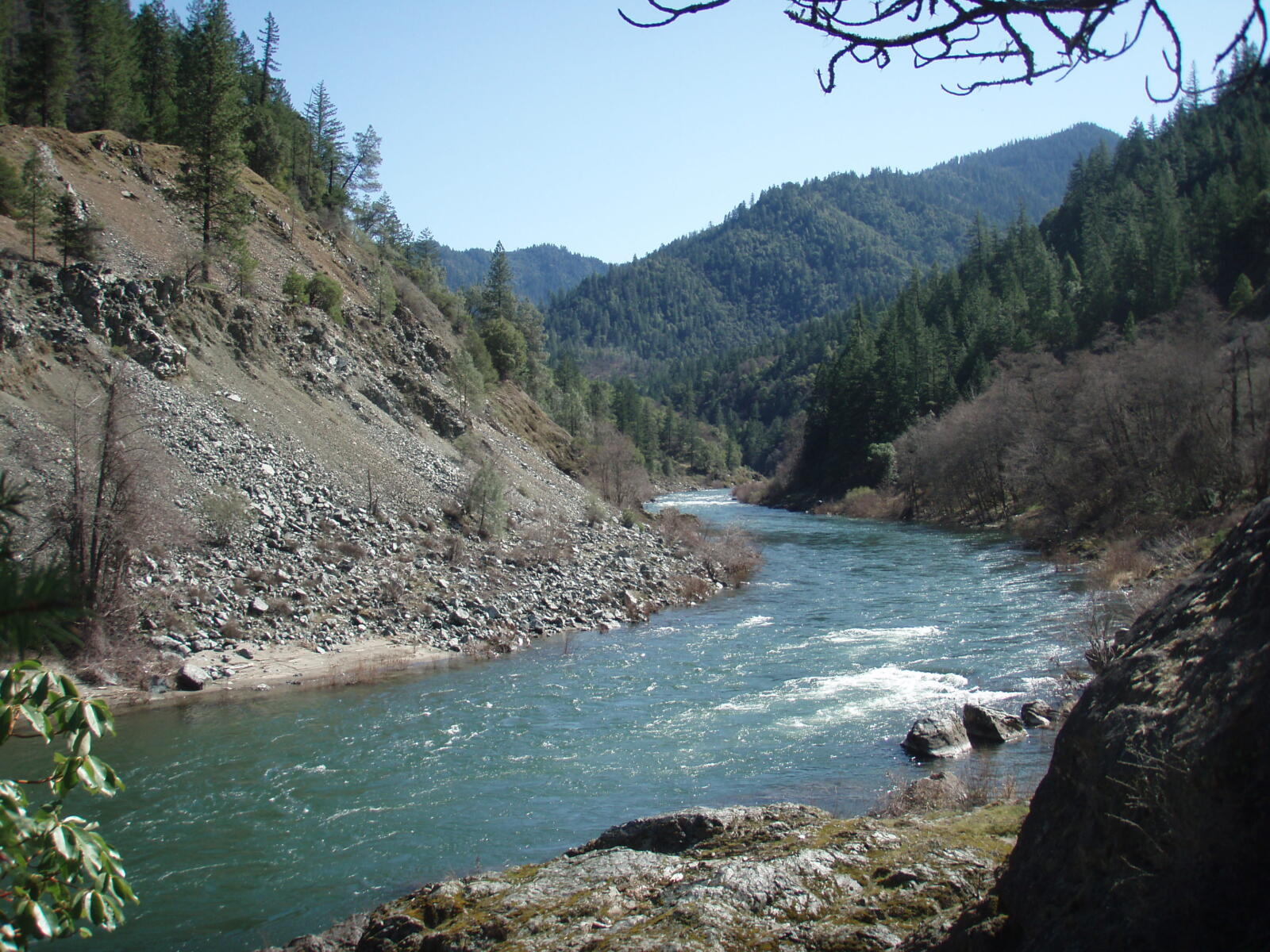
Featured photo: Klamath River, by Summer Burdick, U.S. Geological Survey (public domain).